28. Metal-Free Ferromagnetism in Triangulene Two-Dimensional Frameworks

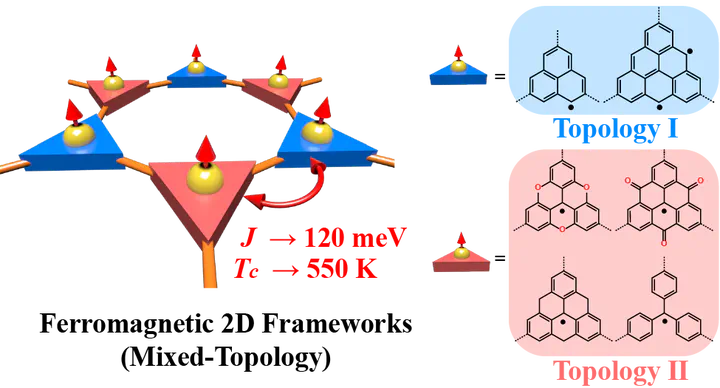 Image credit:
Abstract
Achieving room-temperature ferromagnetism in purely organic two-dimensional (2D) materials remains a fundamental challenge. Here, we introduce a mixed-topology strategy to induce strong ferromagnetic (FM) coupling in metal-free 2D frameworks. By covalently connecting non-Kekulé polycyclic aromatic hydrocarbon (PAH) radicals with distinct sublattice topologies, we rationally break inversion and time-reversal symmetries and thereby unlock intrinsic FM order in π-conjugated 2D networks. Leveraging this concept, we computationally designed a family of 32 FM 2D frameworks featuring spin-1/2 and hybrid spin-1/2–spin-1 honeycomb lattices. First-principles calculations revealed that these organic 2D frameworks are robust FM semiconductors with tunable spin-dependent bandgaps (0.9–3.8 eV). Remarkably, they exhibit record-high FM couplings of up to 127 meV, spin-splitting energies exceeding 2 eV, and crossover (Curie) temperatures above 550 K, ensuring ferromagnetic order stability far beyond room temperature. The strong FM interaction originates from substantial overlap between half-filled, delocalized π-orbitals, which enhances direct magnetic exchange while suppressing antiferromagnetic superexchange. These findings establish an effective design principle for metal-free FM semiconductors and pave the way for flexible magnets for next-generation spintronics and quantum technologies.